Owsley County Dog Registration Information
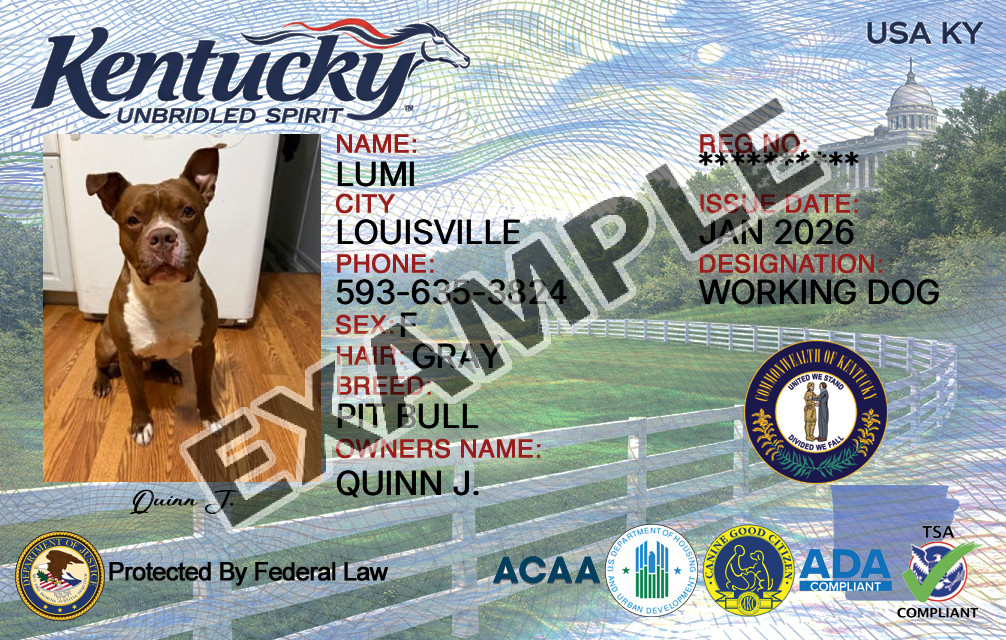
Service Dogs and Emotional Support Animals in Owsley, Kentucky
If you’re searching where do I register my dog in Owsley County, Kentucky for my service dog or emotional support dog, it helps to separate two different things: (1) your local dog license in Owsley County, Kentucky (a county/local requirement that may apply to many dogs), and (2) the legal status of a service dog or an emotional support animal (ESA) (which is not handled through one universal federal registry). This page explains where to register a dog in Owsley County, Kentucky, what you typically need, and how service dogs and ESAs fit into local licensing.
- Dog licensing (sometimes called a dog tag or county dog license) is usually handled locally and often requires proof of rabies vaccination.
- Service dogs are defined by training and disability-related work/tasks. They are not made “official” by buying an ID card or signing up in a federal registry.
- Emotional support animals (ESAs) are not service dogs and generally do not have public-access rights; they may be relevant primarily for certain housing situations.
Where to Register or License Your Dog in Owsley County, Kentucky
The office below is an official county office serving Owsley County residents. If you are trying to get a county dog license (often a dog tag) or confirm local dog licensing requirements Owsley County, Kentucky, start here and ask which department issues dog tags in your area (county clerk, animal control, or another local office).
Owsley County Clerk
| Monday | 8:00 AM – 4:00 PM |
|---|---|
| Tuesday | 8:00 AM – 4:00 PM |
| Wednesday | 8:00 AM – 4:00 PM |
| Thursday | 8:00 AM – 4:00 PM |
| Friday | 8:00 AM – 4:00 PM |
| Saturday | 9:00 AM – 1:00 PM (first Saturday of the month) |
| Sunday | Closed |
Overview of Dog Licensing in Owsley County, Kentucky
What “registering” a dog usually means locally
When people ask “where to register a dog in Owsley County, Kentucky,” they often mean one of these local actions:
- Getting a county dog license (dog tag) for the current year (if required where you live).
- Confirming rabies vaccination documentation is current and on file if the local process requires it.
- Updating ownership/contact details connected to a dog license record (if local rules require or allow it).
County vs. city requirements (why it can vary)
Dog licensing rules can vary by location. In some parts of Kentucky, dog licensing is handled countywide; in other areas, a city within the county may have additional rules or may issue licenses through a city office. Owsley County has Booneville as the county seat; however, licensing responsibilities can still differ based on local ordinances and enforcement practices.
If you’re specifically looking for an animal control dog license Owsley County, Kentucky, the best first step is to call the office listed above and ask: “Which office issues dog tags and handles dog licensing for Owsley County residents at my address?”
What You Need Before Registering a Dog
Common documents and details
Requirements can differ by local policy, but most local dog license processes are designed to confirm you can be contacted and that your dog’s rabies vaccination is current. When you contact the licensing office, be ready with:
- Rabies vaccination certificate (often required to issue a license or dog tag).
- Rabies tag number if provided by the vaccinating veterinarian.
- Owner identification (driver’s license or other photo ID).
- Proof of residence (sometimes requested if licensing is tied to local jurisdiction).
- Dog details such as name, age, sex, color/markings, and breed (or best description).
- Spay/neuter documentation if your local fee schedule varies based on altered status (if applicable).
Service dog or ESA paperwork: what helps (and what doesn’t)
For licensing purposes, local offices typically focus on rabies vaccination and ownership, not on whether the dog is a service dog or ESA. Still, you may want to keep the following organized:
- Service dog: any training records you have (not always required by law), plus a clear explanation of the tasks the dog is trained to perform (for situations where it matters legally).
- Emotional support animal: for housing contexts, documentation from a qualified healthcare provider may be relevant (requirements depend on the specific housing situation and applicable law).
Steps to Register or License a Dog in Owsley County, Kentucky
Step-by-step process (typical local flow)
-
Confirm the correct licensing office for your address.
Start with the Owsley County Clerk and ask whether the county clerk, animal control, or another office issues dog licenses/dog tags for Owsley County residents.
-
Ask what documentation is required.
In many local systems, proof of current rabies vaccination is a key requirement to issue a license.
-
Bring (or provide) your rabies documentation and dog details.
Be prepared to provide basic identifying info for the dog and the owner’s contact details.
-
Pay any applicable fee and obtain your tag/receipt.
Fees, renewal cycles, and tag styles can vary. Ask how often the license must be renewed.
-
Keep records accessible.
Keep your rabies certificate, any licensing receipt, and your dog’s ID information in a safe place.
Service Dog Laws in Owsley County, Kentucky
What makes a dog a service dog
A service dog is generally a dog that is individually trained to do work or perform tasks for a person with a disability. The key elements are:
- Disability-related need for assistance.
- Training to perform specific tasks or work that helps with that disability.
Licensing vs. legal status
A service dog’s legal status is separate from local dog licensing. Even if your dog is a service dog, your local area may still require a standard dog license and current rabies documentation. In other words:
- Dog license (local): relates to local animal control and public health rules.
- Service dog status (legal): relates to disability accommodations and the dog’s training to perform tasks.
Common questions you may be asked in public
In many public-access situations, staff typically cannot demand medical records or insist on seeing an ID card. If it’s not obvious what the dog does, the focus is usually on whether the dog is required because of a disability and what tasks it is trained to perform. Regardless of status, the dog should be under control and housebroken in public settings.
Emotional Support Animal Rules in Owsley County, Kentucky
What an emotional support animal (ESA) is
An emotional support animal is an animal that provides comfort or emotional support that may help with symptoms of a disability. ESAs are most commonly relevant in certain housing contexts. Unlike service dogs, ESAs are typically not defined by being trained to perform specific tasks.
Local dog licensing still may apply
ESA status does not usually replace local requirements for a dog license in Owsley County, Kentucky. If your area requires licensing and rabies documentation for dogs, those local requirements may still apply to ESAs.
Public access: ESA vs service dog
ESAs generally do not have the same public-access rights as service dogs. If you’re trying to understand what is allowed in a store, restaurant, courthouse, or other public setting, it matters whether the dog is a trained service dog performing disability-related tasks versus an ESA providing comfort.
Dog License vs. Service Dog vs. Emotional Support Animal (ESA)
| Category | Dog License (Local) | Service Dog | Emotional Support Animal (ESA) |
|---|---|---|---|
| Primary purpose | Local identification and compliance (often tied to rabies/public health and local animal rules). | Assists a person with a disability by performing trained tasks/work. | Provides comfort/emotional support; commonly relevant for certain housing situations. |
| Who issues/handles it | Local office (county/city) such as clerk or animal services/animal control, depending on jurisdiction. | Not “issued” by a universal government registry; status is based on training and disability-related need. | Not “issued” by a universal registry; may rely on disability-related documentation in specific contexts (often housing). |
| Rabies proof commonly required | Often yes (varies by local rule). | Often still required for local licensing if your area licenses dogs. | Often still required for local licensing if your area licenses dogs. |
| Training requirement | No special training required for licensing. | Yes—trained to perform specific tasks or work. | No task-training requirement (generally). |
| Public access | Not applicable (licensing does not grant access rights). | Generally permitted where the public is allowed, provided the dog is under control and housebroken (subject to applicable law and specific circumstances). | Generally no special public-access rights compared with pets (subject to applicable law and specific circumstances). |
| What you “register” | A local license record and tag/receipt for the dog. | Typically nothing with a county office; you may still license the dog like any other dog. | Typically nothing with a county office; you may still license the dog like any other dog. |
Frequently Asked Questions
What You May Need
-
1Proof of rabies vaccinationCertificate and/or rabies tag number from your veterinarian.
-
2Proof of residencyMay be requested depending on how licensing is administered locally.
-
3IdentificationPhoto ID for the dog owner/keeper.
-
4Spay or neuter documentation (if applicable)Some places use different fee schedules based on altered status.
-
5Payment for licensing feeAsk the office which payment methods are accepted.
Quick reminder
If your main goal is compliance (or to avoid issues if your dog gets loose), focus on the local steps: confirm the correct office, bring rabies documentation, and ask whether a county dog tag is required for your address in Owsley County.
Register A Dog In Other Kentucky Counties
Select your county below to get started with your dog’s ID card. Requirements and license designs may vary by county, so choose your location to see the correct options and complete your pup’s registration.
- Adair Dog License Cards
- Allen Dog License Cards
- Anderson Dog License Cards
- Ballard Dog License Cards
- Barren Dog License Cards
- Bath Dog License Cards
- Bell Dog License Cards
- Boone Dog License Cards
- Bourbon Dog License Cards
- Boyd Dog License Cards
- Boyle Dog License Cards
- Bracken Dog License Cards
- Breathitt Dog License Cards
- Breckinridge Dog License Cards
- Bullitt Dog License Cards
- Butler Dog License Cards
- Caldwell Dog License Cards
- Calloway Dog License Cards
- Campbell Dog License Cards
- Carlisle Dog License Cards
- Carroll Dog License Cards
- Carter Dog License Cards
- Casey Dog License Cards
- Christian Dog License Cards
- City of Lexington Dog License Cards
- City of Louisville Dog License Cards
- Clark Dog License Cards
- Clay Dog License Cards
- Clinton Dog License Cards
- Commonwealth of Kentucky Dog License Cards
- Crittenden Dog License Cards
- Cumberland Dog License Cards
- Daviess Dog License Cards
- Edmonson Dog License Cards
- Elliott Dog License Cards
- Estill Dog License Cards
- Fayette Dog License Cards
- Fleming Dog License Cards
- Floyd Dog License Cards
- Franklin Dog License Cards
- Fulton Dog License Cards
- Gallatin Dog License Cards
- Garrard Dog License Cards
- Grant Dog License Cards
- Graves Dog License Cards
- Grayson Dog License Cards
- Green Dog License Cards
- Greenup Dog License Cards
- Hancock Dog License Cards
- Hardin Dog License Cards
- Harlan Dog License Cards
- Harrison Dog License Cards
- Hart Dog License Cards
- Henderson Dog License Cards
- Henry Dog License Cards
- Hickman Dog License Cards
- Hopkins Dog License Cards
- Jackson Dog License Cards
- Jefferson Dog License Cards
- Jessamine Dog License Cards
- Johnson Dog License Cards
- Kenton Dog License Cards
- Knott Dog License Cards
- Knox Dog License Cards
- LaRue Dog License Cards
- Laurel Dog License Cards
- Lawrence Dog License Cards
- Lee Dog License Cards
- Leslie Dog License Cards
- Letcher Dog License Cards
- Lewis Dog License Cards
- Lincoln Dog License Cards
- Livingston Dog License Cards
- Logan Dog License Cards
- Lyon Dog License Cards
- Madison Dog License Cards
- Magoffin Dog License Cards
- Marion Dog License Cards
- Marshall Dog License Cards
- Martin Dog License Cards
- Mason Dog License Cards
- McCracken Dog License Cards
- McCreary Dog License Cards
- McLean Dog License Cards
- Meade Dog License Cards
- Menifee Dog License Cards
- Mercer Dog License Cards
- Metcalfe Dog License Cards
- Monroe Dog License Cards
- Montgomery Dog License Cards
- Morgan Dog License Cards
- Muhlenburg Dog License Cards
- Nelson Dog License Cards
- Nicholas Dog License Cards
- Ohio Dog License Cards
- Oldham Dog License Cards
- Owen Dog License Cards
- Pendleton Dog License Cards
- Perry Dog License Cards
- Pike Dog License Cards
- Powell Dog License Cards
- Pulaski Dog License Cards
- Robertson Dog License Cards
- Rockcastle Dog License Cards
- Rowan Dog License Cards
- Russell Dog License Cards
- Scott Dog License Cards
- Shelby Dog License Cards
- Simpson Dog License Cards
- Spencer Dog License Cards
- Taylor Dog License Cards
- Todd Dog License Cards
- Trigg Dog License Cards
- Trimble Dog License Cards
- Union Dog License Cards
- Warren Dog License Cards
- Washington Dog License Cards
- Wayne Dog License Cards
- Webster Dog License Cards
- Whitley Dog License Cards
- Wolfe Dog License Cards
- Woodford Dog License Cards
